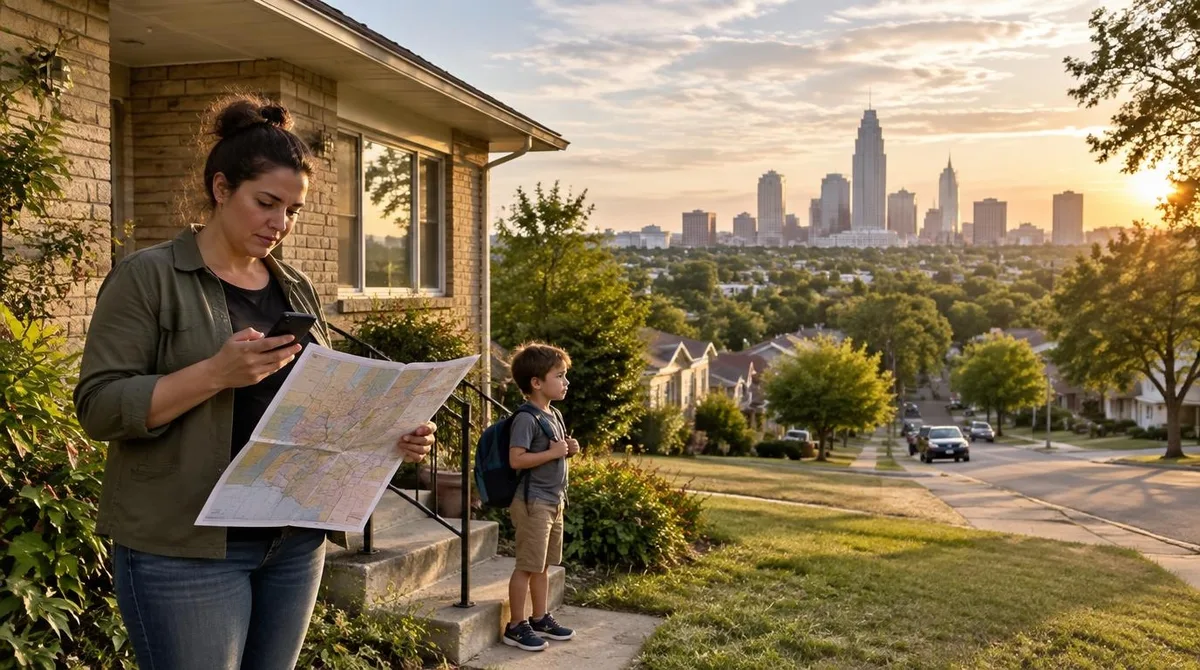
Your home address, not your preference, usually decides which public school your child attends. Every Tulsa-area district divides itself into attendance zones — fixed geographic areas, one per school — and the zone you live in points to an assigned elementary, middle and high school. The exception is a transfer, which most districts allow but which depends on space.
The practical takeaway is simple: verify before you rely on an assumption. Real estate listings, neighbor anecdotes and even a district map glance can be wrong. The district's own boundary lookup, tied to your exact address, is the only answer that counts, and enrollment staff will confirm it if you call.
Tulsa is Oklahoma's second-largest city, as Travel Oklahoma notes in its profile of the city, and that scale shows up in its schools: multiple districts and many campuses serve families across the metro, each with its own zone map and its own transfer rules. That is why the first step is knowing which district you live in, not just which school is closest.
What is an attendance zone, and why does mine matter?
An attendance zone is the boundary a school district draws around a neighborhood so it knows which students belong to which school. Districts use zones to balance enrollment, plan bus routes and forecast how many classrooms each building needs. When you register a child, your zone determines the school that must accept them.
Zones matter most when they change. Districts redraw boundaries when neighborhoods grow, when buildings open or close, or when enrollment shifts. Families who bought a house partly for a specific school can find that school reassigned. Boundaries can also matter for anything tied to your address — bus eligibility, for example — so it pays to know your zone rather than guess.
One caution: the closest school is not always the assigned school. Zone lines follow streets, creeks and other features that have nothing to do with driving distance. A campus two blocks away may sit in a different zone than your street.
How do I find my assigned schools in Tulsa?
Start with the district, not a search engine. Most Oklahoma districts, including Tulsa Public Schools and the suburban districts around it, publish an online boundary or attendance-zone lookup. You type in your home address and the tool returns the assigned elementary, middle and high school. Treat the result as official only if it comes from the district's own website or staff.
If the online tool confuses you — older addresses, new construction and annexed streets are common trouble spots — call the district's enrollment office. Have your address ready exactly as it appears on utility bills or county records, and ask them to confirm all three school assignments, not just the elementary. Write down the date and the name of the person who confirmed it.
New to the area or buying a home? Verify before you close. A school named in a listing is a marketing claim, not an assignment. The district lookup is the record that governs.
Who draws the boundaries, and can they change?
School boards draw and redraw attendance zones. It is a board decision, usually made after staff study enrollment projections, building capacity and transportation costs, and usually after public input. That means a boundary is a policy choice, not a permanent fact, and it can change with a board vote.
Families get a say. Proposed boundary changes typically go through public review before a board adopts them, and public comment at those meetings is where residents push back or ask for exceptions. If a redraw is underway in your district, the board agenda is the document to read — the proposal, the maps and the timeline are all in the packet.
Watch for grandfathers. When districts redraw zones, they often let currently enrolled students finish at their existing school, sometimes with conditions such as family-provided transportation. The details vary by district and by plan, so read the specific policy rather than assuming an exception applies.
What are my transfer options if I want a different school?
You generally have three paths, and each works differently.
- Intra-district transfer. This is a request to move your child to another school within the same district. Districts approve these based on space, and popular schools fill first. Application windows matter; many districts set them annually.
- Inter-district transfer. This moves your child across district lines — from one Tulsa-area district into another. Oklahoma law allows open transfers between districts, subject to capacity, and both the sending and receiving districts play a role in the process.
- Charter and magnet options. Some Tulsa campuses are charters or magnet programs with their own application and lottery processes, separate from neighborhood assignment. A magnet seat is won by application, not by address.
What this means in practice: the neighborhood school is your guaranteed seat, and everything else is an application. If a transfer is denied for lack of space, the assigned school remains your child's place, and you can reapply in a later window.
Deadlines are the detail families miss most. Transfer windows, required forms and capacity decisions all run on the district's calendar, and a missed window can mean waiting a full year. Check the district's transfer page each winter and spring, before the next school year's enrollment closes.
How do boundary questions connect to bigger district decisions?
Boundary lines do not sit still while districts face harder choices. Tulsa Public Schools has faced a recommendation to close or consolidate campuses, which our coverage tracks at Tulsa Schools Face a Recommendation to Close or Consolidate Campuses. When buildings close, zones get redrawn and students get reassigned, so consolidation news is boundary news. We covered a connected angle in Tulsa Schools Face a Recommendation to Close or Consolidate Campuses.
Enrollment timing matters too. The district opened 2026-27 enrollment in January, as we reported in Tulsa Public Schools Opened 2026-27 Enrollment on January 12, and enrollment periods are when assignment questions surface — new families registering, transfers pending, addresses verified. If you are new to the district, that is the season to get your paperwork in order.
For readers following the wider civic picture, our Local News section covers the school board and city decisions that shape these questions, and our community coverage follows the neighborhoods where boundary changes land.
What this means for Tulsa families
Three habits will keep you ahead of the system. First, verify your assigned schools with the district's own lookup and confirm by phone if anything is unclear. Second, read board agendas when boundary changes or closures are proposed — that is where the decision actually happens, before it reaches the news. Third, calendar the transfer windows if you want a school other than your assigned one, and apply early.
None of this requires special access. The lookup tools, the agendas and the transfer forms are public. The families who fare best are the ones who treat the district office like what it is: a records keeper that will answer a careful question.