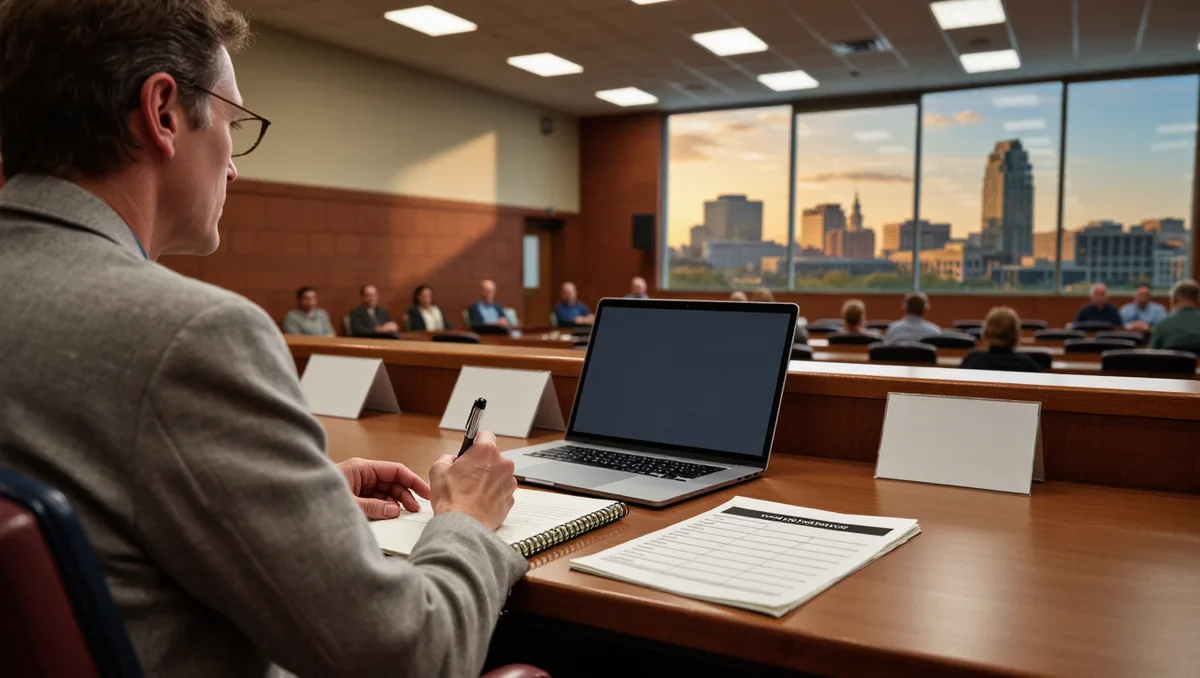
A community newspaper covers a school board well when it treats every meeting as a public record, not a press event. That means reporting what was decided, who voted which way, and what the decision costs or saves residents. It also means showing up when nothing dramatic is on the agenda, because that is where the next controversy starts.
The stakes are practical. A school board sets the tax rate, hires the superintendent, and decides which campuses stay open. Readers who miss one budget vote can spend years paying for it. Good coverage turns a two-hour meeting into the few facts a family actually needs.
What makes a paper a community paper in the first place is worth naming. Sociologists define a community as a group of people sharing a locality and a feeling of common identity — what Pure Sociology describes as a territorial group with a "we-feeling" and shared conditions of common life. Wikipedia's overview of the concept adds that durable relationships beyond family ties define a sense of community, shaping people's roles in institutions such as government and school. A school board sits at the center of that web. Coverage that forgets it is writing for neighbors, not for a generic audience, loses the room.
What does good school board meeting coverage look like?
It answers three questions in the first paragraph: what happened, who decided it, and when residents will feel it. A story that opens with the vote count and the effective date has done its job before the second sentence. A story that opens with atmosphere — the crowded room, the tense mood — has not.
The best meeting stories share habits. They name every board member who voted, not just the ones who spoke. They quote the exact motion, because motions are the legal unit of a meeting and paraphrase blurs them. They distinguish clearly between what the board decided and what the superintendent's staff recommended, since those are different acts by different people.
They also cover the boring meetings. A workshop on bus routes or a routine bond oversight report is where a reporter learns the district's normal numbers. Without that baseline, the reporter cannot recognize the abnormal when it arrives. Readers benefit too: steady coverage means no meeting passes without a record.
How should a reporter handle a school budget?
Line by line, and slowly. A school budget is a set of choices about people: how many teachers, how many aides, how much for maintenance. The story is rarely the total. It is what changed from last year and who asked for the change.
Practical steps for budget coverage: get the proposed budget before the hearing, not after; compare it to the prior year's adopted budget; find the fund balance and note whether the district is drawing it down or adding to it; and identify the largest single line item, because that is where cuts and raises actually live. Ask staff to walk through any figure that moved more than a small amount. Public finance staff will usually explain — the request itself is a records matter, and a paper that knows how to file a public records request in Tulsa and Oklahoma rarely stays stuck for long.
Attribution matters most here. A projected shortfall is the administration's projection, not a verified fact. A savings estimate is the vendor's estimate. Write the source into the sentence: "the administration projects," "the company estimates." Readers forgive careful hedging. They do not forgive being misled.
How do you report on school closures and consolidations without burning trust?
Closure and consolidation stories are the hardest assignment in local education reporting. Families hear a recommendation as a verdict. The reporter's job is to keep the two apart and to keep the district's own timeline honest.
The discipline is simple to state. Report a recommendation as a recommendation, with the vote that produced it and the votes still required. Report an enrollment figure as the district's own count. Report a capacity study as a study, with its author named. Tulsa readers have seen this play out as Tulsa Schools face a recommendation to close or consolidate campuses, and the same rule applies anywhere: an announced intention is not an outcome. We covered a connected angle in Tulsa Schools Face a Recommendation to Close or Consolidate Campuses.
Trust survives hard coverage when the paper is even-handed about it. Cover the parent who lost a school and the administrator who must balance a budget with the same care. Let both explain themselves in their own words. Skip the editorial adjective — "heartbreaking," "callous" — and let the facts carry the weight. Readers notice when a paper grieves with them and when it reports to them, and the second is the harder and more valuable service.
What this means for readers who want better coverage
Our analysis of what separates strong school board coverage from weak is not about resources. Small papers with one reporter do it well; large ones botch it. The difference is method.
- Read the agenda packet before the meeting, including the attachments. The real story is often on page 47.
- Get the minutes afterward and check your draft against them. Minutes are the official record; quotes from memory are not.
- Track votes over time. A member's pattern on spending questions tells readers more than any single vote.
- Write for the parent who missed the meeting, not for the people who attended it.
- Correct errors fast and visibly. A paper that corrects itself is trusted more, not less.
Readers can hold their own paper to this list. If coverage never names a dissenting vote, or never explains where the money goes, ask why in a letter to the editor. Local journalism improves fastest when its neighbors are specific about what they need.
Why school board coverage is local news at its most local
The keyword phrase "local news worcester ma" points at the same truth from a different city: wherever the district is, the coverage problem is identical. A school board in Massachusetts and one in Oklahoma differ in funding formulas and state law, but not in the basic transaction. Board members exercise public power in public, and a community paper is the standing witness.
That witness role is fragile. It depends on showing up, reading the record, and treating every reader — the teacher, the taxpayer, the board member's own neighbor — as owed the same accuracy. Papers that manage it become part of the community's machinery, as permanent as the building the board meets in. Papers that don't become one more thing the town used to have.