Tulsa has a real safety net. Community clinics take patients without insurance, some providers charge on a sliding scale tied to what you earn, and free screening events pop up across the metro through the year. The hard part is not whether help exists. It is knowing which door to knock on first, and what to bring when you do.
This guide walks through the main paths: community health centers, free and charitable clinics, sliding-scale providers, and the screening events that offer checkups and tests at no cost. It also covers the paperwork that makes any of these visits go smoothly. The word "find" does real work here — Merriam-Webster defines it as "to come upon by searching or effort," and that is exactly what this process takes. None of these services advertise loudly. You find them by effort.
One note before we start. Programs change their hours, eligibility rules and fees, sometimes often. Treat everything below as a map, not a contract, and confirm the details with the provider before you go.
What counts as free or low-cost care?
Free care means you pay nothing at the visit. Low-cost care usually means one of two things: a flat discounted fee, or a sliding scale, where the charge rises and falls with your income. A sliding-scale clinic asks for proof of income — a pay stub, a benefits letter, sometimes just your own statement — and sets your fee from there. Someone with no income may pay nothing or a small flat amount; someone working part-time pays more, but far less than a standard bill.
These categories matter because they point you to different places. A truly free clinic often runs on volunteers and donations and may see patients only one or two days a week. A community health center bills insurance when you have it and discounts when you don't. Knowing which one fits your situation saves you a wasted trip.
Where do community health centers fit in?
Community health centers are the backbone of care for people without insurance, here and nationwide. They are clinics that receive federal support specifically to serve everyone who walks in, insured or not, and to adjust charges based on income and family size. In Tulsa, they handle the everyday work of staying healthy: checkups, blood pressure management, diabetes care, vaccinations, referrals to specialists.
The practical advantage is continuity. A screening event can tell you your blood sugar is high. A health center is where you go back, three months later, to see whether it came down. If you expect to need care more than once a year, establishing yourself at a center is usually the stronger move than chasing one-off free events.
What about free clinics and charitable providers?
Free and charitable clinics sit alongside the health centers. They are typically nonprofit operations that rely on volunteer doctors, nurses and dentists, and they serve people who fall through other gaps — often those without insurance whose income is too high for public programs but too low for private coverage. Hours can be limited and waitlists common, so call ahead rather than assuming walk-in availability.
Some charitable providers focus on a specific service. Dental care, for example, is the most common gap in the safety net; medical care is easier to find than a low-cost cleaning or filling. Vision screenings and prescription assistance programs also show up in this tier. When you call any clinic, ask directly: what do you offer, what do you charge someone in my situation, and when is the next available appointment?
How do screening events and mobile clinics work?
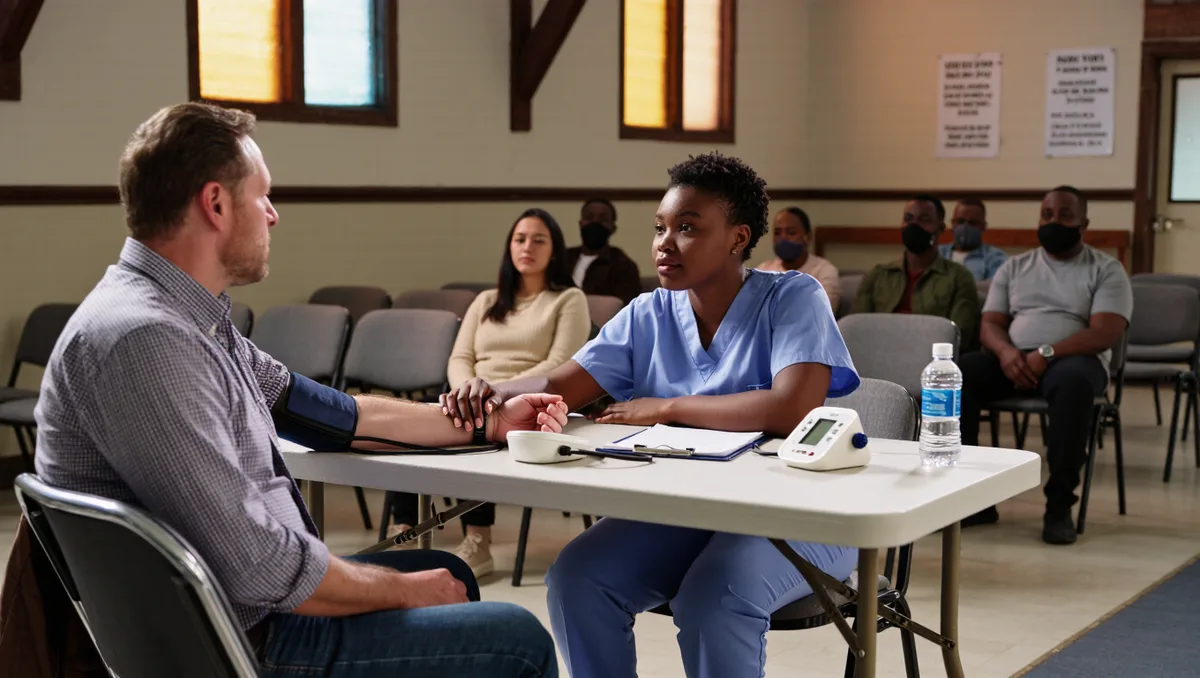
Screening events are one-day or recurring gatherings where volunteers offer specific tests and checkups at no cost — blood pressure readings, blood sugar checks, dental exams, vision checks, sometimes mammograms or other screenings through mobile units. Churches, schools, community centers and health fairs host them. Local health agencies and nonprofit organizations publicize them through community calendars and partner groups.
Two things make these events work better for you. First, go early: lines form, and popular services such as dental sometimes fill up. Second, bring paper. If the event finds something that needs follow-up — and screenings often do — you will want a written record to hand the clinic that takes the next step. A screening is a starting point, not a treatment plan.
Community institutions help spread the word about these events. Your Tulsa City-County Library card connects you to more than books — library staff routinely point residents toward local services, and branches post community notices. Neighborhood groups do the same; if you belong to one of the Tulsa neighborhood associations, its meetings and mailing lists are a quiet but reliable source of news about health fairs nearby. We covered a connected angle in Beyond Books: What Your Tulsa City-County Library Card Actually Covers.
What should you bring to your first visit?
Preparation is the difference between a smooth appointment and a second trip. Most low-cost providers will ask for some version of the same short list:
- Photo ID — a driver's license, state ID or passport.
- Proof of income — recent pay stubs, a benefits award letter, or your most recent tax return. This is what sets a sliding-scale fee, so it matters most.
- Proof of address — a utility bill or lease, since some programs serve specific areas.
- A list of medications you take, including doses, plus any medical records you have.
Call before you go and ask exactly what their intake requires. Policies differ clinic to clinic, and a five-minute phone call prevents the most common frustration: arriving without the one document that determines your fee.
What this means for your first steps
Our analysis of how the safety net fits together comes down to this: match the door to the need. For ongoing care, start with a community health center and ask about their sliding scale. For a single need — a dental problem, a screening, a prescription — look for the charitable provider or event that targets it. For everything else, use the free connectors: the library, a neighborhood group, or a call to community service lines that can search what is available near your address.
Seniors have a further layer. Tulsa's senior centers offer meals and Medicare counseling alongside social programming, and Medicare questions — what a plan covers, what it costs — are exactly the kind of thing a counselor can untangle. Food access ties in too; Tulsa's farmers markets accept SNAP, which stretches a grocery budget and keeps fresh produce in reach while you sort out the medical side. For related coverage, see Tulsa Senior Centers: Meals, Medicare Help and What They Cost.
None of this replaces a doctor-patient relationship. But it lowers the barrier to getting one. The system rewards persistence: make the call, bring the papers, go back for the follow-up. That is the whole method.
The takeaway
Free and low-cost health care in Tulsa is not one place. It is a set of doors — health centers, charitable clinics, one-day screening events, counselors at senior centers — each with its own rules and hours. Start with the door that matches your need, confirm the details by phone, and bring proof of income and ID to every first visit. What the evidence here establishes is the shape of the system; the hours and fees at any specific provider remain the one thing you must verify yourself, because they change.