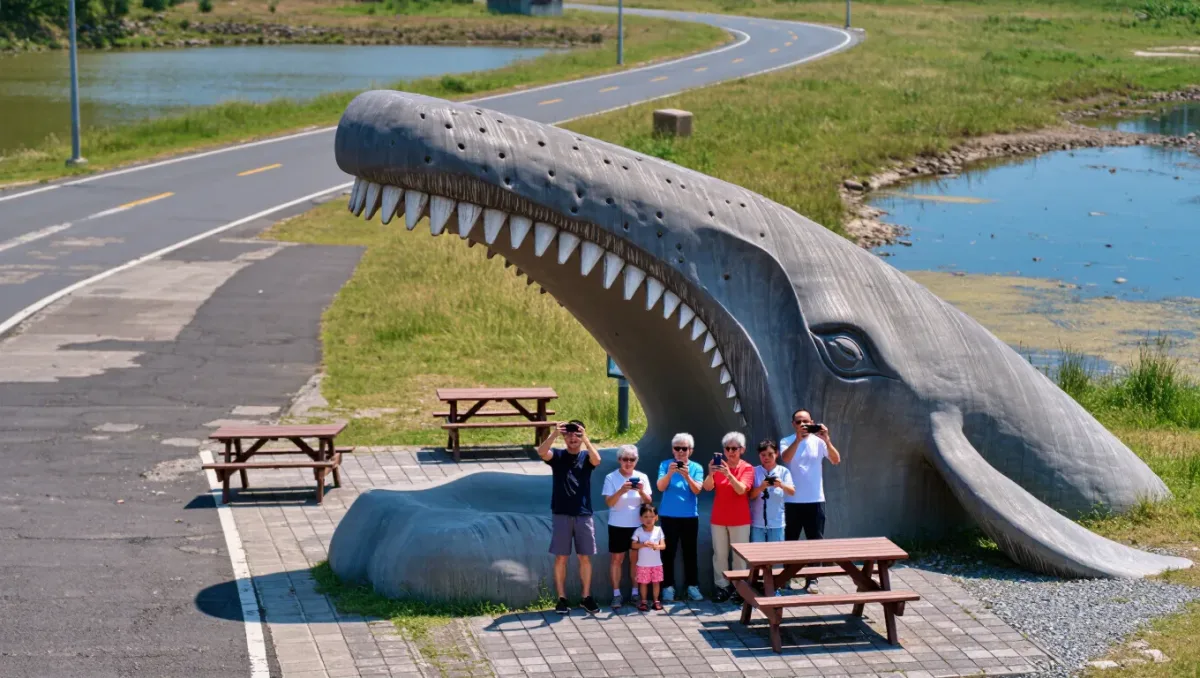
The Blue Whale of Catoosa sits about 15 minutes east of downtown Tulsa, and it began in 1972 as a wedding anniversary present. Hugh Davis built the smiling concrete whale in a pond off old Route 66 as a gift for his wife Zola, travelers started stopping, and the structure became the most photographed roadside landmark in Oklahoma, per the Oklahoma Historical Society. In the centennial year of Route 66 — the highway was commissioned in 1926 — the stops along Tulsa's stretch are carrying the heaviest traffic of their modern era.
For residents playing tour guide this summer, here is the one-tank itinerary: six stops, all within about an hour of downtown, each with its own story and none requiring more than a parking spot and a camera.
What is there to see east of the city?
The Blue Whale anchors the east side. The pond, picnic tables, and gift shop occupy the old highway alignment just off Interstate 44 at the Catoosa exit, and the stop costs nothing to visit. Continue east on the old alignment and the road runs through Foyil, home to Ed Galloway's Totem Pole Park — a nine-story totem pole and folk-art grounds built by a former Foyil teacher over decades starting in 1937, per the park's custodians, making it one of Oklahoma's oldest roadside art sites.
Between the two, the route crosses small-town main streets that preserve the highway's commercial strip era: motor-court layouts, gas-station canopies, and diner buildings that predate the interstate.
And on the west side of downtown?
West of the Arkansas River, the Route 66 Historical Village on Southwest Boulevard collects the corridor's oil-boom history around a towering derrick and interpretive grounds. The Cyrus Avery Centennial Plaza at the 11th Street bridge pairs the East Meets West sculpture — a Model T meeting a horse-drawn wagon — with river views and the district's centennial programming.
The west stretch also carries the corridor's working future: port and industrial traffic on the river bridges remind drivers that the highway and the McClellan-Kerr waterway both chose this crossing for the same reason.
What is in between?
Downtown and midtown hold the walkable stops. The Center of the Universe, on the Boston Avenue pedestrian bridge, is a concrete circle with an acoustic quirk — sounds echoed from the surrounding rail underpass return distorted and amplified to anyone standing at its center. The mechanism is architectural, not mystical, per acoustics explanations from local engineers, but it has become one of the city's most-visited oddities.
On 11th Street, Buck Atom's Cosmic Curios — the space-cowboy-fronted souvenir stand built in 2019 — represents the corridor's new generation of roadside architecture, deliberately designed in the midcentury idiom the highway lost to the interstate. Nearby, the restored Meadow Gold neon sign stands on a dedicated corner as the strip's best surviving piece of midcentury commercial signage.
How should you sequence the drive?
The efficient loop runs about half a day: start at the Avery Plaza downtown, cross the river to the Historical Village, return east along 11th Street for Buck Atom's and the Meadow Gold corner, stop at the Center of the Universe, then run old 44 east to the Blue Whale and finish at Totem Pole Park in Foyil. The reverse works fine for anyone starting in the suburbs.
Summer practicalities decide the experience. Morning light is best for photographing the whale's west-facing grin, most stops have no shade, and centennial-weekend traffic along 11th Street adds time that the itinerary should absorb. Water and sun protection matter more than any admission fee — every stop on the list is free.
What does each stop actually cost?
Nothing at the gate, in every case above: the whale, the plaza, the village, the totem park, the Meadow Gold corner, and the Center of the Universe are all free to visit. The costs are incidental — gift-shop purchases at the whale and Buck Atom’s, parking downtown, and fuel across a loop of roughly 60 miles door to door. For a family outing in a season when a single theme-park day elsewhere in the region runs to three figures, the corridor is the cheapest full day of entertainment in the Tulsa area.
The stops also scale to any window. A lunch-hour visit can cover the plaza and the acoustic circle; a Saturday morning can absorb the full eastern run to Foyil; and a centennial weekend can justify the day-plus version that continues toward Stroud and the Rock Café on the way to Oklahoma City. Because the sites sit on or beside working roads rather than inside a park, hours are effectively dawn to dusk with no gates closing.
Accessibility is better than the roadside aesthetic suggests: the plaza, Buck Atom’s, and the whale all offer level parking and short paths, and the totem park’s grounds are firm enough for strollers in dry weather. Only the Boston Avenue bridge circle involves stairs or ramps depending on approach, which downtown signage makes clear.
Why do these stops matter in the centennial year?
Roadside landmarks are the centennial's working infrastructure. The highway's anniversary travel surge concentrates exactly where the photographable, stoppable, giftable sites are, and the corridor's small operators — gift shops, diners, and motel conversions — depend on that traffic. The state's centennial grant programs have been funding signage, facade work, and new attractions along the route through 2025 and into 2026, per the Oklahoma Route 66 Centennial Commission, which is why the stretch keeps adding reasons to stop rather than reasons to pass through.
What to watch next
Watch for centennial caravans announcing their Tulsa-area stop times, for new centennial-funded markers and murals appearing along the corridor through the year, and for the Blue Whale's own anniversary programming — the 1972 landmark will mark more than five decades on the highway during its centennial season. The stops are close, free, and open: that is the whole point of the road.