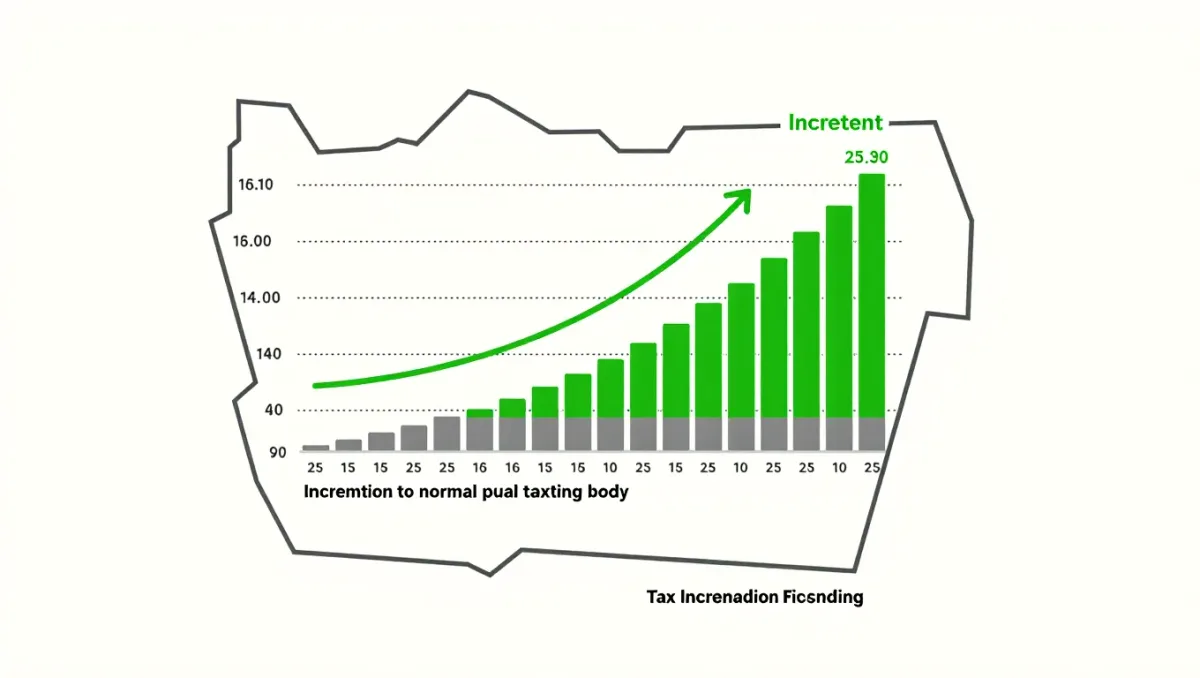
Tax increment financing — TIF — is the least visible and most consequential tool in Tulsa's development toolbox. The mechanism: when a city designates a TIF district, it freezes the property tax base inside the boundary at its designation-year level. As redevelopment pushes property values up, the new tax revenue — the increment — is diverted from schools, county government, and other taxing bodies and spent instead on infrastructure and incentives inside the district, typically for 25 years, per Oklahoma's Local Development Act.
Tulsa has used the tool for decades in its downtown core and has debated expanding it repeatedly. Understanding how it works explains most of what gets built — and most of what gets argued about at City Council.
How does the money actually flow?
A TIF district starts with a baseline: the total assessed value of all property inside the boundary in the year of designation. Property owners inside the district keep paying their taxes exactly as before — nothing about their bills changes. What changes is the destination of the growth. If a district's assessed value rises from $100 million to $150 million over a decade, the taxes on the original $100 million keep flowing to schools, the county, and city government as usual, while the taxes generated by the added $50 million flow into the TIF fund.
The city then spends that increment in two ways. Pay-as-you-go reinvestment funds public work — streets, utilities, parking structures, parks — inside the boundary. Increment-backed bonds borrow against the projected future increments to fund bigger projects sooner, which concentrates both the power and the risk of the tool.
What has Tulsa used TIF for?
Downtown is the case study. Tulsa's downtown TIF districts, created under the Local Development Act, have captured increment that helped fund parking infrastructure, streetscape work, and project-specific incentives across the central business district, per City of Tulsa records. The logic was straightforward: downtown in the 1990s and 2000s had the historic stock and the infrastructure but lacked the private capital to reposition it, and the increment capture turned the district's own growth into its redevelopment fund.
Subsequent conversations about new districts — along transit corridors, around hospital anchors, and in neighborhoods with disinvestment — have followed the same template with sharper debate, because TIF boundaries determine which growth gets reinvested where.
Why is TIF contested?
Because the increment is other taxing bodies' money. School districts, county government, and technology center districts all levy property tax, and every dollar diverted to the TIF fund is a dollar those entities do not receive for the district's 25-year life. School funding is the sharpest edge of the argument: Oklahoma school finance is sensitive to local property valuation, and a large TIF in a fast-appreciating area can shift meaningful cost onto the state aid formula.
Supporters answer with the counterfactual: without the tool, the redevelopment — and even the baseline growth — would not have happened, so the taxing bodies are better off with the TIF than with a stagnant district. That claim is empirically checkable but genuinely hard to prove, which is why TIF hearings turn on assumptions about what would have happened without the designation.
How do residents engage TIF decisions?
TIF designations and amendments run through the City of Tulsa's public process: a plan document with the boundary, the projected increment, and the intended uses; Planning Commission review; and City Council approval, with notice to the affected taxing bodies, per state statute. The plan documents are public, and the projections in them — growth rates, timelines, project lists — are the numbers worth reading, because everything about a TIF's performance is judged against its own plan.
Two questions do most of the analytical work at any hearing: how much of the projected increment depends on projects already announced, and what happens to the district's obligations if growth runs below plan.
How is TIF different from the city’s other development funding?
Tulsa stacks several tools, and they get conflated. General obligation bonds, approved by voters, borrow against property taxes levied citywide for public projects — they are citywide money spent on public work. The 2016 Vision package, funded by a countywide sales tax, operated the same way at county scale. Neither captures growth; both spend existing taxpayer money approved at the ballot.
TIF is different in kind: it spends no one’s new money. It redirects growth that would not exist without redevelopment, and its discipline comes from its arithmetic — if the district does not grow, the fund stays empty and the tool does nothing. That self-limiting quality is TIF’s best argument and its honest limitation: it cannot seed a district that the market has no intention of improving.
Opportunity zones and federal New Markets credits sit at yet another layer, attached to investors rather than geography-specific taxing bodies. The practical takeaway for readers following any Tulsa project: the funding stack is usually TIF increment plus tax credits plus conventional debt plus some public infrastructure, and no single tool explains a project’s viability. When a council agenda item mentions a district, the useful question is which layer the public is being asked to fund and what risk shifts to the city if projections miss.
Oklahoma’s Legislature has revisited the Local Development Act’s terms repeatedly, and amendments to school-impact provisions are a recurring session topic, so the statutory frame itself is a moving part worth tracking.
What to watch next
Watch the city's downtown housing and riverfront agendas, both of which lean on increment economics, and any Council dockets proposing new or amended districts — each one redraws where Tulsa's growth taxes get reinvested for the next quarter century. TIF is a slow tool with long memories; the designations made now will still be allocating tax dollars in 2050.