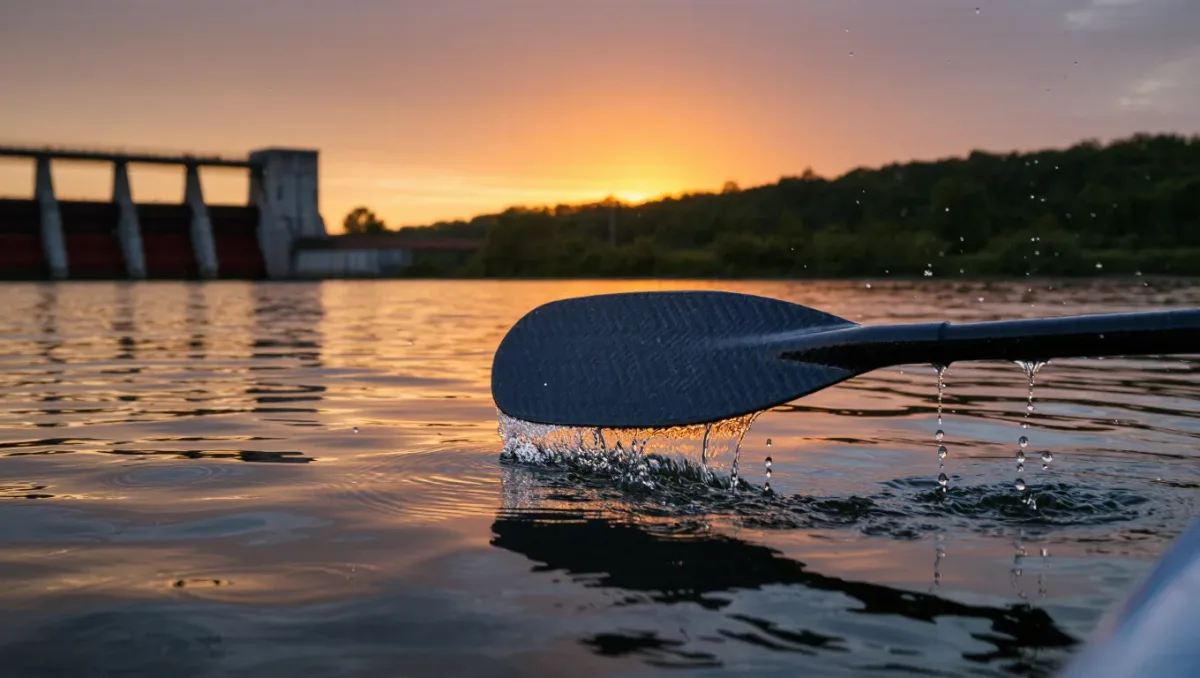
Zink Lake reopened in the summer of 2023 after the rebuilding of Zink Dam, the structure that has pooled the Arkansas River through midtown Tulsa for about a century, per the City of Tulsa. The rebuilt dam does what the old one never could: it controls the lake's level with engineered gate structures instead of a fixed crest, which lets the city hold flat water for paddle sports through the recreation season and drop the pool for maintenance and flood operations.
Two seasons of operations later, the project stands as the most visible result of Tulsa's riverfront investment push — and the proof of concept for everything the city has argued about the river since the 2016 Vision package passed.
What actually changed at the dam?
The original Zink Dam was a fixed structure: it pooled the river to a set height, and only a flood could change it. Sediment accumulated behind it, its concrete deteriorated, and the flat water it created was unreliable enough that the river parks along it went underused for decades. The rebuilt dam replaces that geometry with operable gates. Raised, they hold a dependable pool across the Zink Lake reach for kayaks, canoes, paddleboards, and rowing; lowered, they pass sediment and flows through, restoring something closer to the river's natural channel during non-recreation periods.
The design also shapes the current itself. Gate configurations create river features — waves and eddies — that paddlers use, turning a reach of river that once ran flat or dry into the region's most accessible in-town paddling venue, per the city's riverfront materials.
What has the lake meant for the river parks?
The River Parks trail system that runs along both banks is the direct beneficiary. The trail network — one of Tulsa's most-used public assets — now borders a dependable water feature instead of a mud flat in dry years, and usage along the Zink reach reflects it, per city reporting on trail traffic. Outfitters and programs that rent paddlecraft and run instruction operate on the lake in season, giving the corridor an activity economy it previously lacked.
The event angle followed the infrastructure: regattas, paddling races, and river festivals that require predictable water can now be scheduled on a lake whose level is a management decision rather than a weather outcome.
How was the project funded?
Zink Dam's rebuild rode on Tulsa's 2016 Vision package and city capital programs, per City of Tulsa records — the voter-approved sales tax strategy that has funded the riverfront, parks, and public-safety capital since its passage. The dam project's public funding model is the point: a fixed-crest dam has no revenue stream, so the private capital that transforms skylines never touches it. Only public funding rebuilds public infrastructure like this, which is why the 2016 vote was the decisive moment for the lake rather than any subsequent project announcement.
What does it mean for the broader river plan?
Zink is the pilot for Tulsa's larger river argument. The Arkansas River through Tulsa has been managed by aging low-water dams for a century, and successive city administrations have weighed rebuilding more of them to create the continuous recreational water the city's peers market. Zink's results feed that decision: operational experience with gates, maintenance costs, flood-performance data, and the economic activity along the rebuilt reach all become inputs to the next dam question.
The development spillover is the other input. Property and amenity investment along the Zink reach — trailside businesses, apartment projects, and program space — tests whether recreational water actually capitalizes into adjacent land value, the assumption underlying the river's entire development case.
What did the reopening change downtown?
The lake sits minutes from downtown and the Gathering Place, and its reopening re-knit that triangle. The trail connections along the Zink reach now carry commuter and recreational traffic between the core, the park, and the midtown neighborhoods, and the water feature gives the corridor a destination logic it lacked: people come to the river, rather than past it.
For the city’s talent-retention argument, the lake is the rare amenity that photographs well and costs residents nothing to use. Recruitment materials and economic-development pitches have leaned on it accordingly, and out-of-market visitors — especially in the paddling community — discovered a venue that barely existed before 2023. The measure that matters to city hall is repeat visitation, and two seasons of outfitter operations and scheduled events suggest the reach has moved from novelty to fixture.
The developer response has been slower than the amenity itself, which is typical. Waterfront value capitalizes over cycles, not seasons, and the parcels with the clearest lake frontage are largely public parkland — meaning the private spillover lands on adjacent blocks rather than on the water’s edge. That pattern is exactly why trailhead commercial nodes and adjacent-block projects, not lakefront towers, are the development story to follow along the Zink reach.
What are the honest limits?
A gate dam is an operated asset, not a build-and-forget one: sediment management, gate maintenance, and flow operations are permanent budget lines, and drought years constrain the recreation pool no matter the engineering. The lake's reach is also bounded — it transforms miles, not the whole river — and its benefits concentrate at the access points, which is why trailhead and park improvements along the reach carry as much weight as the dam itself.
What to watch next
Watch the city's operations reporting through the 2026 recreation season, the private investment announcements along the Zink reach, and the next low-water dam decisions upstream and downstream — each one extends or leaves broken the continuous-water chain Zink Lake proved out.