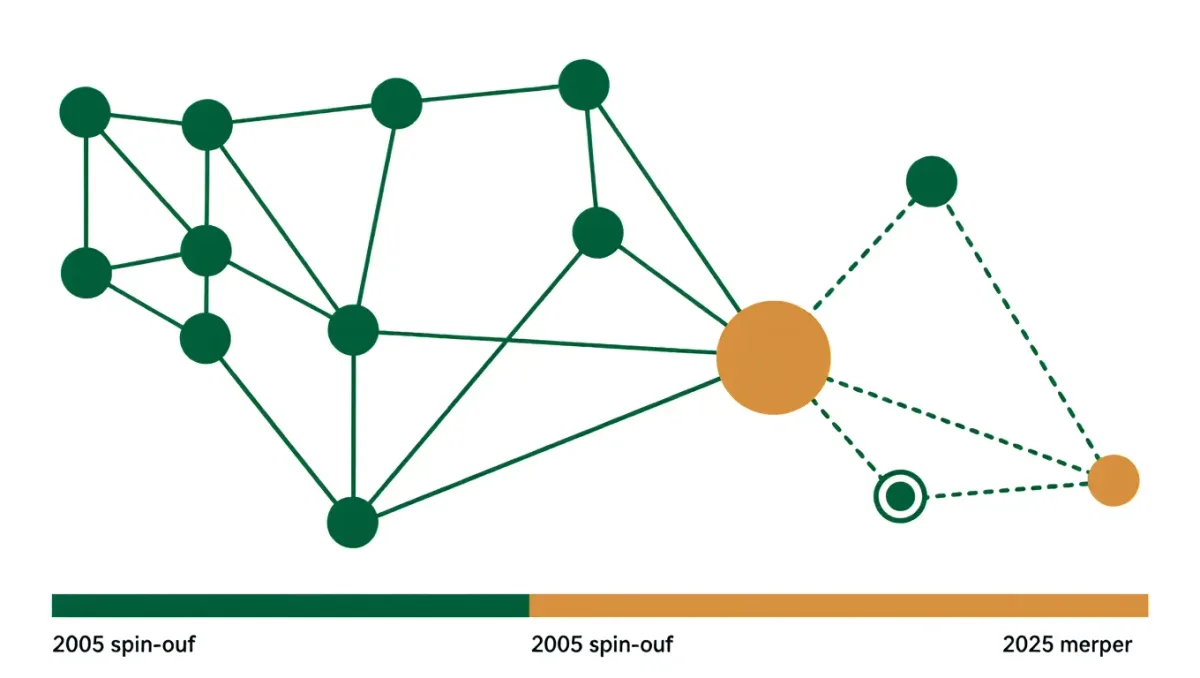
Boeing completed its roughly $4.7 billion acquisition of Spirit AeroSystems on December 8, 2025, per Boeing's announcement and Reuters reporting, reabsorbing the world's largest independent aerostructures supplier two decades after spinning it out. For Tulsa, the deal rewires the metro's defining industrial relationship: Spirit's Tulsa campus — which manufactures aerostructures, including components tied to Boeing's 737 program — now operates inside Boeing rather than across a contract from it, joining a supply chain the two companies have shared, and squabbled over, since 2005.
The transaction closed after the Federal Trade Commission cleared it on December 3, 2025, with carve-outs: portions of Spirit's Belfast operations and the sites building Airbus work, such as plants in Kinston, North Carolina, and Casablanca, were excluded and divested toward Airbus. Tulsa's facilities, whose work centers on Boeing programs, stayed in the main deal.
Why did Boeing buy its own supplier back?
The logic was vertical reintegration after years of supply chain strain. Spirit was created in 2005 when Boeing sold its Wichita and Tulsa-area commercial structures plants to a private-equity-formed company, a bet that independent suppliers would cut costs. Two decades later the arrangement had inverted: Spirit lost money building Boeing structures, Boeing absorbed the quality and delivery consequences — most visibly after the January 2024 Alaska Airlines door-plug accident, which involved a Spirit-built fuselage section — and both companies' finances argued for reunion. Boeing's stated aim is quality control and production rate stability on the 737 line, the highest-volume narrowbody program in the West.
The December 2025 close ended that fifteen-year structural experiment, with Boeing taking the Boeing-related operations and Airbus picking up the plants that build its own structures.
What does Tulsa build, and why does it matter?
Spirit's Tulsa campus is one of the metro's largest aerospace manufacturing sites, with a workforce in the thousands and a product line spanning structural assemblies and systems for Boeing commercial programs. The plant's roots run to the era when Tulsa built bomber components during World War II — the campus carries eighty years of aerostructures continuity that few American sites can match. In the region's aerospace cluster, which counts American Airlines' maintenance base, Boeing's local operations, L3Harris, NORDAM and dozens of suppliers, Spirit's plant is the manufacturing counterweight to the base's maintenance economy.
Ownership changes the commercial relationship but not the work on the floor in the near term: the same workers build the same assemblies. What changes is the apparatus around them — pricing, capital investment decisions, quality systems and the accountability chain that used to end at a contract boundary now runs inside one company. Tulsa's aerospace workforce has lived both models; the site was Boeing's before it was Spirit's.
What are the risks and the upside for Tulsa?
The upside is investment. Standalone Spirit underinvested in aging facilities because losses left no capital; as a Boeing division, the Tulsa site competes for internal funding alongside Boeing's own plants, and reintegration announcements have repeatedly mentioned modernizing the acquired campuses. Payroll continuity through the transition was the immediate local concern, and the carve-out structure — with Airbus taking the Airbus-work plants — kept Boeing-program sites like Tulsa inside the merged company rather than in a divestment queue.
The risk is concentration. Boeing's commercial production rates now determine Tulsa's manufacturing pulse more directly than before: a 737 rate increase lifts the campus, another quality freeze would hit it without a contract buffer. The metro's aerospace economy is already Boeing-weighted; December's close tightened the coupling. State officials have courted diversification — defense work, space, and the region's MRO economy — precisely to soften that sensitivity.
The workforce equation behind the merger
Every scenario for the merged company runs through hiring. Aerospace manufacturing across the United States faces a retirements cliff — a large share of the current aerostructures workforce is past age 55 — and Tulsa competes for machinists, composite technicians and engineers against every other Boeing hub. The local pipeline runs from Tulsa Tech's machining and aviation programs through area colleges' engineering tracks, and the merged company's Tulsa site inherits Spirit's recruiting challenge with Boeing's compensation scale behind it, a combination regional workforce boards describe as the best sourcing position the campus has had in years.
Training investment is the tell to watch. Reintegrated plants typically see the parent company fund equipment and certification programs that a struggling standalone could not, and every announced training dollar in Tulsa signals which way the integration is leaning. Conversely, the metro's other aerospace employers — the maintenance base, defense contractors, aftermarket specialists — recruit from the same pool, and any hiring surge at the merged campus raises wage pressure across all of them. That competition is, by regional economics standards, a good problem: it means the skills Tulsa trains are the skills Tulsa keeps.
What should Tulsa watch next?
Three markers tell the story through 2026: Boeing's integration disclosures on the acquired sites in its quarterly filings, 737 production rate decisions out of Renton, and any announced capital projects for the Tulsa campus — the clearest signal that reintegration means investment rather than mere accounting. Employment data from the state's labor office will confirm whether the transition preserved the workforce, which both companies committed to do.
The longer arc: Tulsa spent two decades as a supplier city, selling aerostructures across a contract line. It now spends the next chapter as a Boeing city again — with the scale advantages, and the dependencies, that title always carried.