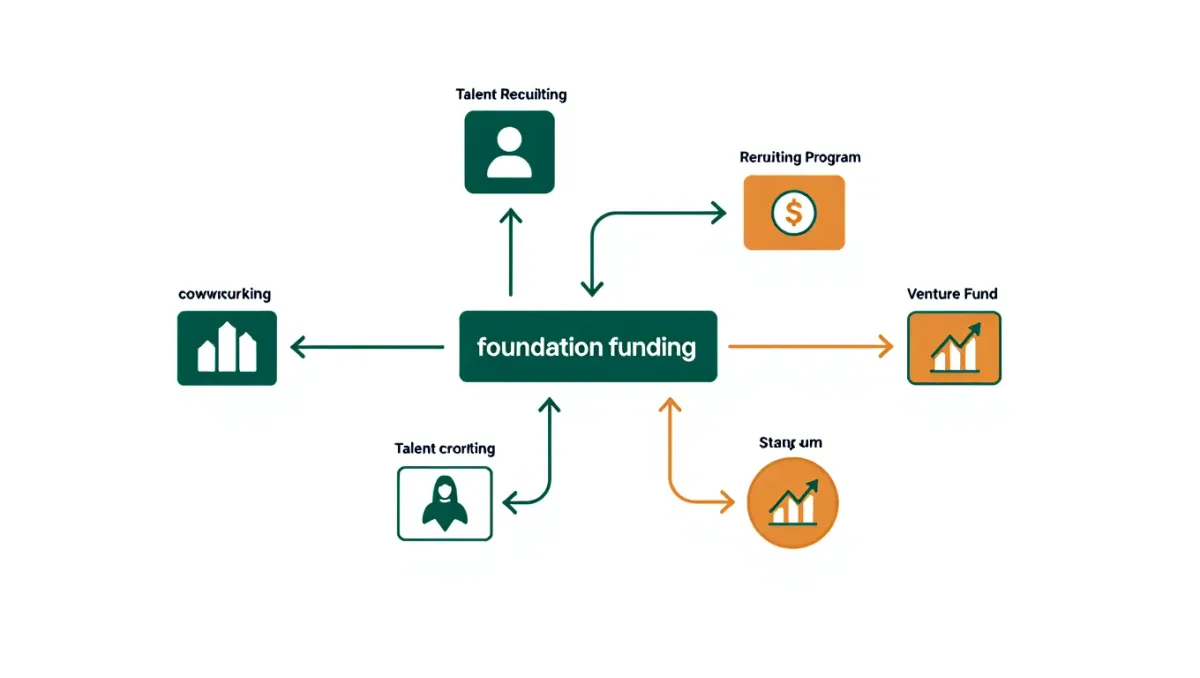
Tulsa's startup economy runs on infrastructure most cities expect the market to provide: a flagship coworking hub in 36 Degrees North, an economic development engine in Tulsa Innovation Labs, a recruiting program in ATTRACT that pays companies to relocate tech workers, and a homegrown venture fund in Atento Capital. Nearly all of it traces to George Kaiser Family Foundation, whose philanthropic bet is that Tulsa — a metro with energy wealth, an aerospace base and cheap downtown real estate — can grow a technology sector the way it once grew oil one.
A decade into the experiment, the stack has produced measurable companies, jobs and a talent pipeline. Here is how the pieces fit and where the model still strains.
What is 36 Degrees North?
36 Degrees North opened downtown in 2016 as the ecosystem's physical anchor: a nonprofit coworking space housing startup teams, remote workers and the small-service firms that orbit them. Its role is gravitational — demo days, founder programs, investor visits and the informal hallway network that a scattered startup community otherwise lacks. For a founder relocating to Tulsa, it functions as the default landing pad and the fastest introduction to whoever in the metro can help.
The hub model matters more in Tulsa than in bigger markets precisely because the density is manufactured rather than organic. Tulsa's startup population is spread across a car-dependent metro; the coworking floor is where that population becomes a community with deal flow.
What does Tulsa Innovation Labs do?
Tulsa Innovation Labs, launched in 2020 by the Kaiser foundation, is the strategy layer: an organization that picks focus sectors — cybersecurity chief among them, alongside virtual health, energy technology and advanced aerial mobility — and builds programs to grow them. Its logic is comparative advantage: cybersecurity fits Tulsa's existing industrial base and the federal procurement economy; virtual health rides the healthcare systems' scale; energy tech obviously rides the energy headquarters; aerial mobility plays off the aerospace cluster.
The companion piece is ATTRACT, the talent-recruiting program that offers remote workers and company founders financial incentives to relocate to Tulsa and participate in the ecosystem. Recruiting solves Tulsa's structural problem — the metro exports graduates to bigger markets — by importing workers who arrive with salaries, networks and companies attached. The program's cohorts have fed the coworking hub and the startup pipeline the way convention tourism feeds hotels.
Where does venture capital come from?
Atento Capital, the Tulsa-based fund backed by the Kaiser foundation, supplies the local check-writing: early-stage investments in Tulsa companies and, strategically, in firms anywhere that ATTRACT or the ecosystem can recruit to relocate. The design is deliberate — a venture fund that doubles as an economic development tool, using investment as the hook for geographic strategy. Alongside it, regional angel groups, energy-family wealth and the university commercialization channels at OSU and OU's Tulsa campuses fill the earliest rounds.
The honest measure of the model is follow-on: whether Tulsa-seeded companies raise national venture rounds and stay headquartered in Tulsa, or exit to the coasts. The ecosystem's flagship successes in geospatial and cybersecurity have kept local addresses longer than the skeptics predicted, and each one that stays compounds — exits fund angels, angels fund the next cohort, and the cycle starts needing less philanthropy per deal.
What could break the model?
Concentration is the standing risk. The ecosystem's funding runs disproportionately through one family's foundation, whose priorities can shift with leadership and markets; a durable version of Tulsa's stack eventually needs private capital to carry rounds that philanthropy seeded. Talent retention remains the second test — recruiting remote workers is faster than growing them, but imported workers churn at higher rates than natives — and the metro's venture output, while growing, remains a rounding error next to Austin or Denver, a gap no single program closes quickly.
The counterweight is cost and quality of life: office and housing costs a fraction of coastal markets, a commute measured in minutes, and the healthcare and aerospace anchors that give technical workers second-spouse career options. Tulsa does not win talent on scale; it wins on the whole family's economics.
How the ecosystem actually feels from a founder's chair
The practical experience of building in Tulsa differs from bigger markets in ways budgets do not capture. Introductions happen in weeks, not quarters: the metro's business community is small enough that a founder with a working product meets the relevant utility executive, hospital innovation lead or aerospace supplier within one introduction chain. Pilots are the payoff — Tulsa's anchor companies run corporate innovation programs that buy from local startups earlier than their coastal counterparts would, because the relationships sit one phone call away. The downside is the same smallness: every misstep is remembered, talent hiring beyond the imported cohorts is thin, and a founder who burns local goodwill has no anonymous market to reset in.
For transplants, the calculus lands on run-rate. A seed round that buys eighteen months of runway in Austin buys thirty in Tulsa, and the ATTRACT incentive sits on top. Founders who treat the city as an arbitrage leave when the arbitrage ends; founders who plug into the hallway network at the coworking hub tend to stay, because the ecosystem's value is not the discount — it is the access.
What should founders and observers watch?
Three indicators read the ecosystem's health: the ATTRACT cohorts' retention after incentive periods end, the volume of institutional venture rounds into Tulsa-headquartered companies without Kaiser money attached, and the cybersecurity sector's federal contract wins — the focus sector where Tulsa's bet is most testable. A fourth is quieter: whether energy and aerospace corporations start acquiring the startups, which is how a heartland ecosystem matures into its region's real economy.
What to watch next: the annual cycle of demo days and cohort announcements each fall, and the state's innovation legislation, which has expanded Oklahoma's early-stage incentive tooling in recent sessions. The stack Tulsa built is young; 2026 is the year its first cohort of companies either raises institutional money or becomes the cautionary cohort. Either way, the infrastructure now exists to run the experiment again.